How this itinerary works
Here is the short version: three days covers Hangzhou's icons properly. Five days gives the city room to breathe and adds the side of Hangzhou most visitors never find: real tea country and a world-class art district. Seven days is the deep local week, the version of Hangzhou we would show a friend, not a tour group. Every day in every plan below stays within Hangzhou. This city does not run out; most itineraries simply stop looking after day three.
We run small-group tours here, so this plan puts pacing first. It tells you what genuinely deserves a full day, what fits into a morning, and what to skip if you're tired, because a good itinerary is about rhythm, not box-ticking. (If you want the checklist first, our top 10 things to do in Hangzhou is the quick read; this page is the plan.)
Jump to your trip length: 3-Day Plan · 5-Day Plan · 7-Day Plan
Each plan builds on the one before it. The 5-day plan contains the 3-day core at a gentler pace, and the 7-day week contains both. Getting here is easy: Hangzhou is 45–60 minutes from Shanghai by high-speed rail, and we cover that arrival leg in our Shanghai to Hangzhou guide. Getting around is easy too. The metro now runs about a dozen lines and reaches almost everything in this post; we note the station for every stop.
One honest warning before you book anything: check your dates against China's public holidays. During the big national holiday weeks, West Lake is a crowd, not a lake.
The 3-Day Plan
Day 1 — West Lake, done properly
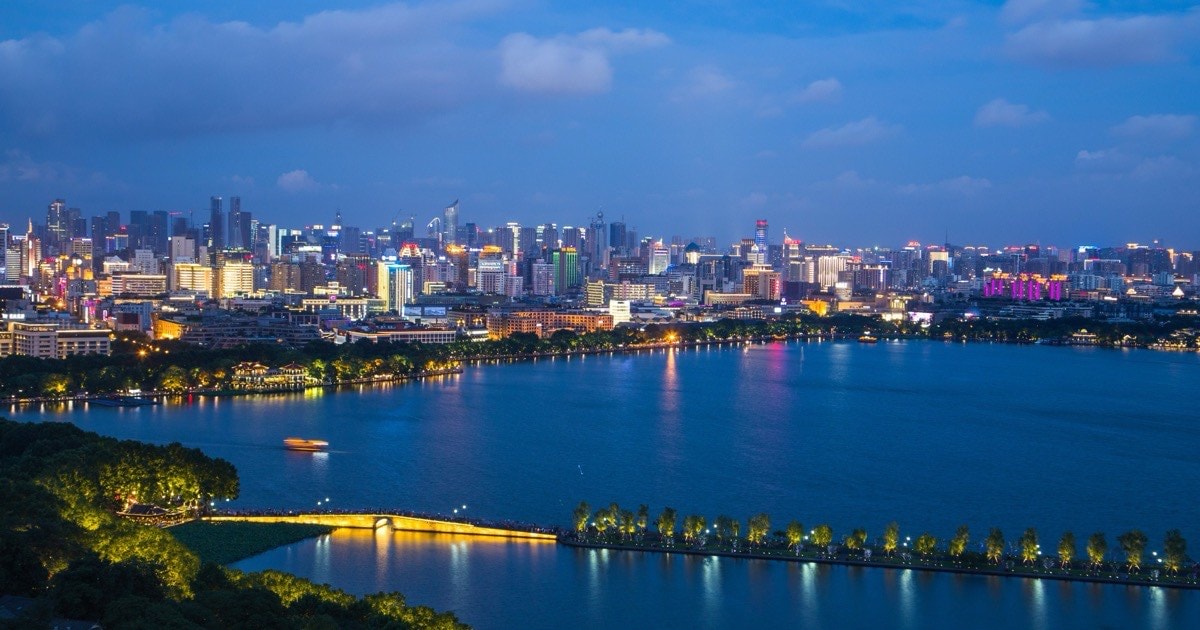
West Lake is free, it is a UNESCO World Heritage cultural landscape, and it deserves a full day, not the two rushed hours most tours give it. Start early. The lake at dawn, with mist still on the water, is the version poets have been writing about for a thousand years. Walk the Su and Bai causeways, take a boat out to the islands to see Three Pools Mirroring the Moon, and reach Leifeng Pagoda in time for sunset. Metro Line 1 to Longxiangqiao puts you a short walk from the lakeshore.
In the evening, walk into Qinghefang, also known as Hefang Street, the old pedestrian street of the Southern Song imperial city. It follows naturally from a West Lake day and feeds you well. Our West Lake guide has the full route, including the quiet stretches most visitors miss.
Day 2 — Lingyin Temple and the Grand Canal
Lingyin Temple is one of China's oldest and most significant Buddhist temples, founded in 328 AD, and the Feilai Feng grottoes beside it hold centuries of carved stone Buddhas. Give it the morning. Here is a practical note that most guides have not caught up with: as of late 2025 the Feilai Feng scenic area dropped its entry fee, but a free timed reservation, booked at least a day ahead through the official mini-program, is now required. The temple itself charges a small entry fee of about ¥30 at the gate. Book the morning slot the day before, and read our Lingyin Temple guide before you go.
Spend the afternoon at the Grand Canal, the Hangzhou end of the ancient waterway that once connected this city to Beijing. This is living canal life, not a museum. Stay for dusk around Xiaohe Street and Gongchen Bridge, when the lights come on over the water. The full walk is in our Grand Canal guide.
Day 3 — Tea hills in the morning, art in the afternoon
Spend the morning in the Longjing tea hills, home of Dragon Well tea. The villages are walkable and surrounded by terraced tea fields, with tastings poured by the families who grow it. Spring is harvest season, when the hills are at their greenest. Our Longjing tea guide covers the villages in detail.
Then close your trip at Tianmuli (OōEli), an arts-and-lifestyle complex of seventeen exposed-concrete buildings designed by Renzo Piano, his only work in Hangzhou. The BY ART MATTERS museum opens at noon and runs to 8pm (closed Mondays), the Tsutaya bookstore is the first in mainland China, and the complex hosts rotating festivals and markets throughout the year. It is the easiest "artsy Hangzhou" stop for a foreign visitor. Take Metro Line 3 to Gudun Road, Exit B, where an underground passage leads directly into the complex. Dinner is on site.
The 5-Day Plan
Days 1 and 2 stay as above, unrushed. The five-day version then splits day 3 into two full days and adds the city's calmer corners.
Day 3 — The real tea day
Do Longjing and Meijiawu in the morning, then continue west into Longwu, the largest West Lake Longjing production area. It is a belt of working tea villages that one local guide honestly describes as a tranquil place ninety percent of Hangzhou people don't know. The classic walk is a loop: start at the Hejiacun village market, walk through it to the Guangming Temple reservoir, then circle back through the tea fields. It is about 8 km and 3–4 hours at a stroll, with ten thousand mu of tea terraces filling every view. If you'd rather not hike, the Jiujie tea-culture street at the town's center (free, open until evening) has teahouses, tea-picking experiences in season, and charcoal-brazier tea in winter.
Day 4 — The artsy day
Start the morning at Dongxin Hechuang Creative Park, a former 1950s telecom factory turned free arts compound. Sixty-one low-rise buildings sit beneath a thousand mature trees, now filled with independent furniture studios, vintage warehouses, florists, cafés, and an antique restaurant. It is the least touristed place in this post. The signage is Chinese-only, which is part of the charm. Take Metro Line 3 to Pingfeng, then walk for ten minutes.
Spend the afternoon and evening at Tianmuli (moved here from Day 3 in the shorter plan): museum, bookstore, dinner, and whatever festival happens to be running.
Day 5 — Xixi Wetlands and the food afternoon
Xixi National Wetland Park is West Lake's opposite: waterways instead of promenades, boats instead of crowds. Take the electric boat network between the wharfs (about ¥60 on top of park entry) and give it the morning. Metro Line 3 stops at South Xixi Wetland, right by the gate. In the afternoon, eat your way through the city, from Longjing shrimp to the rest of the classics in our Hangzhou food guide, then finish back on Hefang Street.
The 7-Day Plan — the deep local week
Most guides tell you to leave Hangzhou after day three. Here is how locals fill a week instead.
Days 1–5 run as above, at an even gentler pace. Then:
Day 6 — Xiang Lake, the quiet mirror
Xiang Lake is the lake Hangzhou keeps for itself: a resort area at the southern end of Metro Line 1 (Xianghu station; the lake is right outside the exit), free to enter and blissfully uncrowded. The New Ten Scenes walking loop follows the whole shoreline, covering about 12 km in 3.5–4 hours. It is easy and flat enough for any walker, passing ancient towpaths, stone bridges, bird islets, and lotus wetlands that bloom through summer. Halfway around sits the Kuahuqiao Site Museum (free, closed Mondays), built over a Neolithic settlement about eight thousand years old. Stay for sunset from the causeways between five and six; it is the best free show in the city.
Day 7 — Art Creation Town, then one last dawn at West Lake
Start early with a second West Lake pass along the western shore and Yanggong Causeway, where the mist settles at dawn and the tour groups never go. Then spend the rest of the morning and early afternoon at Yichuang Town (Art Creation Town) in Zhuantang, the art-school district around the China Academy of Art's Xiangshan campus. The list of draws is remarkable for one compact area: Little Iceland, a flooded former quarry with bare rock walls, emerald water, and a new underwater glass walkway; the BAC art community, an abandoned tower rescued by an art-academy graduate and reopened in 2025 as a free, open art space; the official Black Myth: Wukong retail store, steps from the studio that made the game; and the China Design Museum, designed by Álvaro Siza and holding a Bauhaus collection, with a ¥20 walk-in ticket. One scheduling note: the academy campus itself, designed by Pritzker-winner Wang Shu, only admits visitors on weekends and holidays with an advance reservation. Put Day 7 on a weekend if the campus matters to you. Take Metro Line 6 to the Xiangshan Campus station, itself designed by the academy.
Getting around Hangzhou
The metro is the answer to almost everything, with roughly a dozen lines and growing. For this itinerary: West Lake, Line 1 to Longxiangqiao. Lingyin, Line 1 to Longxiangqiao, then the direct bus or shuttle from the Longxiangqiao hub. Tianmuli, Line 3 to Gudun Road. Dongxin, Line 3 to Pingfeng. Xixi, Line 3 to South Xixi Wetland. Xiang Lake, Line 1 to its terminus. Art Creation Town, Line 6. The metro is still expanding, so lines and exits occasionally change. Map apps are current; older blog posts often are not.
If you'd rather walk it with a local
Every day in this itinerary covers ground we walk professionally, in groups of six or seven, never more. The West Lake day pairs with our West Lake tour, the tea day with the Longjing tea tour, the canal dusk with the Grand Canal walk, and the old-town evening with the dynasties walk. Browse all of them at our guided tours, or start with the Hangzhou overview and choose the days you'd rather not plan alone.
Frequently Asked Questions
Explore More
The Other Side of West Lake
The West Lake day from this itinerary, walked with a local guide.
Where Tea Rang Through the Hills
The full tea-country day — leaf picking, wok firing, farming families.
The Artery of Empires
The Grand Canal at dusk, guided.
Hangzhou overview
Everything Brivience runs in Hangzhou, in one place.