What Is West Lake (Xi Hu)?
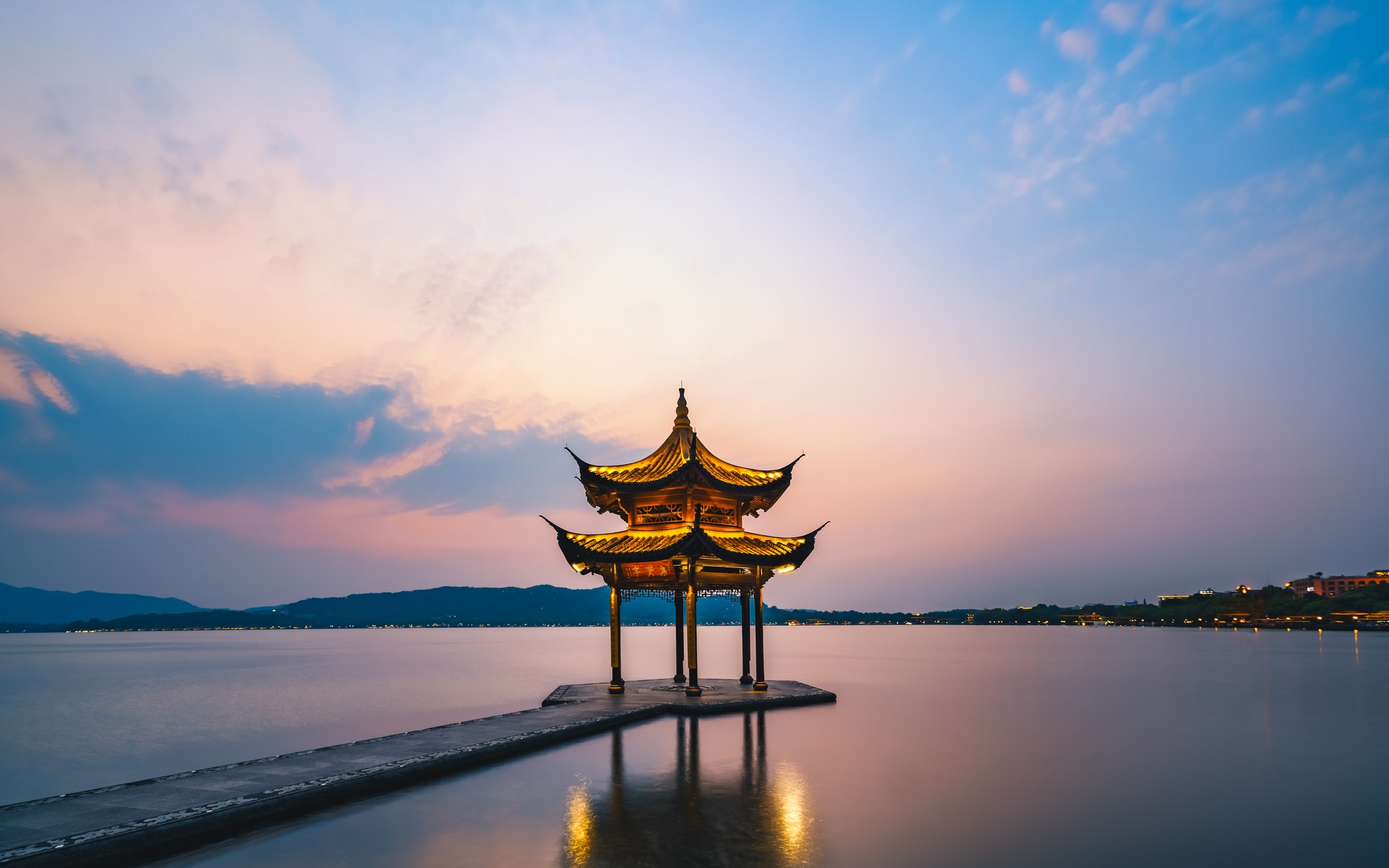
West Lake (西湖, Xī Hú) is the defining landmark of Hangzhou — a 6.39 km² freshwater lake ringed on three sides by forested hills, with the city spreading along its eastern shore. In 2011, UNESCO inscribed it as a World Heritage Site under the name "West Lake Cultural Landscape of Hangzhou," recognizing it as "an idealised fusion between humans and nature" that has shaped garden design and cultural aesthetics across China, Japan, and Korea for more than a thousand years.
The lake's significance isn't simply aesthetic. Two of the most revered figures in Chinese literary history left permanent marks here — and those marks are still visible today. In 822 AD, the poet-governor Bai Juyi (白居易) dredged the silting lake during his tenure in Hangzhou and built the eastern causeway that still bears his name. In 1089 AD, Su Shi (苏轼) — known as Su Dongpo — returned to Hangzhou as governor and built the long crossing that divides the lake's western section. Both causeways are still the main ways to cross the lake on foot. Nearly a thousand years of continuous use is something West Lake offers that almost nowhere else in China can match.
Entry to the West Lake scenic area is free. There's no gate, no ticket, no queue. You walk in from any direction, at any hour. Individual attractions — Leifeng Pagoda, the boat to Three Pools Mirroring the Moon — have separate fees, but the causeways, shoreline paths, and much of the lake's landscape cost nothing.
What most visitors don't realize until they arrive is that West Lake has two distinct personalities. The eastern shore, centred on Bai Causeway (白堤, Bái Dī) and the iconic Broken Bridge (断桥, Duànqiáo), carries nearly all the tourist traffic. The western shore, running along Yanggong Causeway (杨公堤, Yánggōng Dī), is quieter by an order of magnitude — smaller gardens, village-style water clusters, and a landscape that feels removed from the main circuit. The rest of this guide covers both sides of the lake, because both are worth knowing.
A West Lake Map in Words: How the Lake Is Laid Out
There's no single entrance to West Lake, which is exactly what confuses first-time visitors staring at a map. The simplest way to hold the geography in your head: the city sits on the east shore, hills rise on the other three sides, and the lake itself is roughly 3.2 km north–south by 2.8 km east–west, with about 15 km of shoreline all the way around.
East — where you arrive. Longxiangqiao metro station (Line 1) puts you 250 metres from the Hubin waterfront, mid-way along the eastern shore. The Broken Bridge is about 1.2 km north of there along the water — a 15–20 minute lakeside walk. (If Broken Bridge is your first stop, Fengqi Road station is actually the closer exit.)
North — Broken Bridge anchors the northeast corner and leads onto Bai Causeway, which runs just under 1 km west to Gushan, the lake's largest island and its only natural one. Xiling Bridge connects Gushan's far side back to the north shore, so the whole stretch walks as a loop.
West-centre — Su Causeway runs the full 2.8 km north–south across the lake, from the lotus gardens at 曲院风荷 in the northwest down to Huagang (Flower Harbor) in the southwest. It divides the main lake from the quieter inner lakes.
Far west — Yanggong Causeway runs 3.4 km roughly parallel to Su Causeway along the western shore: the quiet side covered later in this guide. Behind it the hills climb into Longjing tea country — the terraced villages in our Longjing tea village guide are only a few kilometres beyond the ridge.
South — Leifeng Pagoda stands over the southern shore, with Nanping Hill and Jingci Temple behind it.
Middle — three small artificial islands sit in the open water: Lesser Yingzhou (home of Three Pools Mirroring the Moon, where the cruise boats land), Mid-Lake Pavilion, and Ruangong Islet (closed to visitors as an ecological reserve). They're reachable only by boat.
| Walk | Distance | Time |
|---|---|---|
| Longxiangqiao station → lakeside | 250 m | ~5 min |
| Longxiangqiao station → Broken Bridge | ~1.2 km | 15–20 min |
| Bai Causeway end-to-end | ~1 km | ~15 min |
| Su Causeway end-to-end | 2.8 km | 40–50 min |
| Yanggong Causeway end-to-end | 3.4 km | ~1 hour |
| Full lake loop | ~15 km | a long full day |
The Eastern Shore: Bai Causeway, Su Causeway, and the Classic Circuit
The eastern circuit is what most visitors do, and it earns its reputation. The landmarks here are genuinely significant — just know what you're walking into on a busy weekend.
Bai Causeway (白堤, Bái Dī) and Broken Bridge (断桥, Duànqiáo)
Bai Causeway runs from Broken Bridge at its eastern end to Gushan Island (孤山, Gū Shān) at its western end, lined with alternating willow and peach trees. The causeway is named after the poet Bai Juyi, though it predates him — the name was given in his honour after his governorship. Broken Bridge is where the lake delivers its most photographed view and, in winter after snowfall, its most famous Ten Scene: "Lingering Snow on Broken Bridge" (断桥残雪, Duànqiáo Cán Xuě). Snow melts unevenly on the arch's sunny and shaded sides, making the bridge appear broken from a distance. Early morning in winter, before the crowds arrive, it's one of the better sights in Hangzhou. On a summer weekend afternoon, the same spot can feel like a crowded intersection.
Su Causeway (苏堤, Sū Dī)
Su Causeway is the longer crossing: 2.8 km end-to-end, with six bridges connecting it to both shores. Su Shi had it built in 1089 using silt dredged from the lake bed. In spring, it's one of the most genuinely beautiful walks in Hangzhou — willow and peach trees on both sides, unobstructed lake views through the gaps. "Spring Dawn at Su Causeway" (苏堤春晓, Sū Dī Chūn Xiǎo) is the first of the Ten Scenes for a reason. The northern section of the causeway tends to be quieter than the southern end near Leifeng Pagoda.
Leifeng Pagoda (雷峰塔, Léifēng Tǎ)
The five-story pagoda on the southern shore originally stood from 975 AD until it collapsed in 1924 — residents had been removing bricks from its base for centuries, believing they had medicinal properties. The current structure was rebuilt in 2002, but the original ruins are preserved in a basement exhibit beneath the modern floor. The sunset view across the lake from the upper levels is worth the entry fee.
Admission: ¥40 adults, ¥20 students and seniors (70+). Hours: 8:00 AM–8:00 PM (April–October); 8:00 AM–5:30 PM (November–March). Purchase tickets in advance on WeChat or Alipay to avoid queues.
The pagoda is tied to one of China's four great folk tales: the White Snake legend (白蛇传, Bái Shé Zhuàn), in which the white snake spirit Bai Suzhen is said to be imprisoned beneath it. The story is deeply embedded in how Hangzhou understands this place, and you'll encounter references to it throughout the lake area.
Three Pools Mirroring the Moon (三潭印月, Sāntán Yìnyuè)
Three small stone pagodas stand in the water near the island of Lesser Yingzhou — one of the most recognizable images in China, featured on the 1 RMB note. The island itself is accessible only by boat. A leisure boat (¥55/person) or painted pleasure boat (¥70/person) includes the round trip and island admission. Operating hours: 8:00–17:00; last boat to the island at 16:00.
Lingyin Temple (灵隐寺)
Lingyin Temple is not on the lake itself — it's about 3.5 km west, tucked into a forested valley near North Peak (北高峰). It's worth a separate visit, particularly for Feilai Peak (飞来峰) and its 470+ Buddhist carvings spanning ten centuries. Since December 2025, it's free to enter, but requires advance reservation via WeChat or Alipay. We've covered it in full in our Lingyin Temple visitor's guide.
The Western Shore: Yanggong Causeway and Where Locals Actually Go
Yanggong Causeway (杨公堤, Yánggōng Dī) runs 3.4 km along the western shore with six bridges connecting to the inner lake. Built in 1508 by the official Yang Mengying to manage flooding, it sees a fraction of the foot traffic of the other causeways. What you find here instead is the lake at a different register: narrower paths, overhanging trees, a sequence of quiet gardens and water clusters, and almost no crowds even during busy seasons. This is where Hangzhou residents come when they want West Lake without the eastern circuit experience.
The route from north to south along Yanggong Causeway:
茅家埠 (Máojiābù)
A Jiangnan-style water village at the northwestern end of the causeway. Traditional wooden buildings have been reconstructed here in the regional style, and the area keeps a rustic, unhurried quality — reeds, narrow channels, the occasional wooden boat. In morning mist, it resembles ink wash painting. There's a dock here for inner lake boat rentals.
乌龟潭 (Wūguī Tán — Turtle Pool)
A small pool connected to the inner lake by a narrow channel. Cherry blossoms bloom late here relative to the rest of the city, and in spring the combination of falling petals and rowboats on the water draws photographers who know where to look. Almost entirely absent from the standard visitor circuit.
浴鹄湾 (Yù Hú Wān — Yuhu Bay)
The Jihong Bridge (霁虹桥, Jìhóng Qiáo) sits low over the water here — wide, flat, and uncrowded enough that you can stand on it and see nothing but water in either direction. One of the cleaner photography spots around the lake if you're looking for angles without other tourists in them.
郭庄 (Guōzhuāng — Guo's Villa)
A classical Jiangnan garden at Yanggong Causeway No. 28, built in 1907 for the Guo family from Fenyang. The garden borrows West Lake scenery as its backdrop: artificial hills, linked pools, covered corridors, and pavilions that look directly over the water. It's intimate in a way the more famous gardens around the lake aren't, and English-language coverage of it is almost nonexistent. Admission ¥10. Hours: 8:00–17:00, last entry 16:30.
杭州花圃 (Hángzhōu Huāpǔ — Hangzhou Flower Nursery)
A working nursery and botanical garden along the southern section of the causeway, popular with Hangzhou residents across the seasons. Seasonal plantings shift through the year — spring brings dense colour, summer transitions to greenery, autumn to late-blooming varieties. Entry is free.
曲院风荷 (Qūyuàn Fēnghé)
One of the Ten Scenes: "Breeze-ruffled Lotus at Crooked Courtyard." The area was a Song Dynasty royal wine-brewing site — qūyuàn (曲院) refers to the fermentation workshop that once operated here. Today it's a lotus garden on the northern stretch of the western shore, and in July and August when the lotus peaks, it's one of the more visually striking corners of the lake. The scale of bloom across the water is something photographs don't fully capture. Free to enter.
Walking the full stretch—from Máojiābù to Qūyuàn Fēnghé—takes about two to three hours at an easy pace. Paired with a morning on the eastern shore, it's what turns a good day at West Lake into a complete one.
For those who want to discover the quieter side of West Lake, our The Other Side of West Lake small-group tour builds on this route—bringing together a curated set of lesser-known spots across the western shore, where the lake feels more intimate and unhurried.
If you want to walk this shore with someone who grew up on it, our small-group Hangzhou tours cover the western side the buses skip — six guests, maximum.
The Ten Scenes of West Lake — A Cultural Map, Not a Checklist
The Ten Scenes (西湖十景, Xī Hú Shí Jǐng) were first formalized during the Southern Song Dynasty (1127–1279), when the imperial court was based in Hangzhou and the lake served as the cultural centre of China. Each scene has a four-character name and is tied to a specific location, season, or time of day. They're cultural references as much as viewing spots — the way Chinese poets and painters historically framed the lake, and still the framework most Hangzhou residents use when talking about it.
Seeking them out actively means orienting your visit around the lake's natural rhythms rather than just moving between landmarks.
| Scene | Location | Best when |
|---|---|---|
| Spring Dawn at Su Causeway (苏堤春晓) | Su Causeway | Mar–Apr, early morning |
| Breeze-ruffled Lotus at Crooked Courtyard (曲院风荷) | 曲院风荷, western shore | Jul–Aug |
| Autumn Moon Over Calm Lake (平湖秋月) | Northeast shore, near Gushan | Sep–Oct, evening |
| Lingering Snow on Broken Bridge (断桥残雪) | Bai Causeway, east end | Winter after snowfall |
| Leifeng Pagoda in Evening Glow (雷峰夕照) | South shore | Year-round, sunset |
| Three Ponds Mirroring the Moon (三潭印月) | Lesser Yingzhou island | Mid-Autumn Festival |
| Listening to Orioles at Willow Waves (柳浪闻莺) | Eastern shore | Spring |
| Twin Peaks Piercing Clouds (双峰插云) | Hills west of the lake | Misty days |
| Viewing Fish at Flower Pond (花港观鱼) | Southwest shore, near 杭州花圃 | Spring |
| Evening Bell at Nanping Hill (南屏晚钟) | Jingci Temple, south shore | Evening year-round |
Not all Ten Scenes require going out of your way. Leifeng Pagoda in Evening Glow and Three Pools Mirroring the Moon are already on the standard circuit. Spring Dawn at Su Causeway costs nothing and just requires arriving before 7 AM. The seasonal ones — Broken Bridge snow, lotus at 曲院风荷 — are worth planning around if timing allows.
Getting to West Lake
By metro — the recommended approach
Take Metro Line 1 to Longxiangqiao Station (龙翔桥站), Exit C4. Walk west along Pinghai Road for 5–10 minutes and you'll reach the eastern lakeside. Line 1 connects directly to both main train stations.
- From Hangzhou Railway Station: Line 1 direct, approximately 4 stops (~15 min, ~¥3)
- From Hangzhou East Station (杭州东站): Line 1 direct toward Xianghu, six stops (~16–20 min), ¥4
- From Hangzhou Airport (萧山国际机场): Take Line 19 to West Lake Cultural Square (西湖文化广场站), transfer one stop on Line 1 to Longxiangqiao — total approximately 1 hour, ~¥8
Metro fares start at ¥2 and are distance-based. Trains run approximately 6:00 AM–11:00 PM daily.
West Lake Cultural Square Station (西湖文化广场, also Line 1) puts you at the northern end of the lake — a slightly longer walk but useful if you're approaching from the north or heading straight for Bai Causeway.
Getting Around the Lake
Bikes — the best option for a full-day visit
Cycling the lake is one of the more enjoyable ways to cover it. Dedicated cycling and pedestrian paths run the full perimeter and along the main causeways.
The official city bikes — the red-and-white dock bikes run by the 叮嗒 (Dīdā) system — are the most affordable option: the first 60 minutes are free, then ¥1/hour, with a ¥5/day cap. To use them, you need either Alipay or WeChat Pay configured with an international Visa or Mastercard. This can't be set up at the lake on the spot — it needs to be done before you arrive in China. If your mobile payment is already configured, unlocking a bike takes about two minutes.
Private rental shops near the lake charge ¥40–60/day for a standard bike and ¥70–80/day for a tandem — the right choice if you haven't set up Alipay before travelling.
Tourist circular bus
A red circular bus runs a fixed route with 13 stops, including Broken Bridge, Su Causeway, and Leifeng Pagoda. ¥30/day for unlimited rides, with bilingual (Chinese/English) guidance on board. Useful if you want to cover the main eastern landmarks without walking the full circuit.
On foot
The full lake perimeter is approximately 15 km — a long day's walk. Most visitors combine walking sections with bikes or the tourist bus. The eastern circuit (Bai Causeway, Su Causeway, Leifeng Pagoda) is a comfortable 3–4 hour walk. The western shore along Yanggong Causeway is a separate 2–3 hour walk, best combined with the eastern circuit if you have a full day.
Best Time to Visit West Lake
West Lake changes significantly with the seasons — the Ten Scenes exist specifically because different parts of the lake have their best moments at different times of year.
Spring (March–May) is the most popular season. Peach and cherry blossoms along Su Causeway and Bai Causeway peak in late March to early April. The cherry blossoms at 太子湾 (Tàizǐwān — Prince Bay) on the southwestern shore are particularly known. Expect larger crowds around the Qingming Festival (early April). For the western shore, this is also prime season: 乌龟潭 has late cherry blossoms and 曲院风荷 shifts into early lotus growth.
Summer (June–August) brings heat and humidity, but also the lotus. 曲院风荷 in July and August — the "Breeze-ruffled Lotus" Ten Scene — is the best it gets, with dense blooms across the water surface. Go early morning to avoid both heat and crowds.
Autumn (September–October) brings clearer skies, lower humidity, and the "Autumn Moon Over Calm Lake" (平湖秋月) Ten Scene at its best around the Mid-Autumn Festival. Osmanthus trees bloom in September across the lake area — the scent carries across the water. Autumn is underrated as a time to visit.
Winter (November–February) is the quietest season and the one most visitors overlook. Crowds are minimal outside the Spring Festival holiday. If snow falls, Broken Bridge becomes the most photographed spot in Hangzhou. Without snow, winter's main draw is the quality of light and the absence of people.
Time of day matters as much as season. The eastern shore at 6 AM is a completely different experience from 10 AM. Locals exercise here at dawn — tai chi on the lakeside platforms, groups cycling the causeways — and the atmosphere is genuinely calm. By mid-morning the tourist circuit is in full operation.
Avoid Golden Week (October 1–7) and the May Day holiday (May 1–5) unless you're comfortable with very large crowds at the main eastern landmarks. The western shore is more manageable even during peak periods.
What to Know Before You Go
Entry to the scenic area is free. There is no gate or admission charge to West Lake. Leifeng Pagoda (¥40), the Three Pools Mirroring the Moon boat (¥55–70), and 郭庄 Guo's Villa (¥10) each have their own fees. Walking the causeways, sitting by the water, and exploring the western shore costs nothing.
Mobile payment is essential. Cash is not widely accepted at bike docks, smaller food stalls near the lake, or transit top-ups. Alipay and WeChat Pay are the standard — both support linking international Visa or Mastercard. This needs to be set up before you travel, not at the lake.
How long do you need? A focused half-day (4–5 hours) covers the main eastern circuit: Bai Causeway, Su Causeway, Leifeng Pagoda. A full day lets you add the western shore — and the western shore is what makes the difference between seeing West Lake and actually understanding it. Two days allows for Lingyin Temple separately, an evening in the Grand Canal district (a 20-minute taxi north, at its best after 4pm), and a more unhurried pace overall.
What to skip: The Inner Lake circular boat route (内湖游船) that doesn't include the Three Pools island — it's slow and the views from the causeways are comparable. The tourist stalls near Broken Bridge sell the same things you'll find in every market in China.
Lingyin Temple is not on the lake — it's a separate trip 3.5 km west. Since December 2025 it's free, but requires advance reservation via WeChat or Alipay at least one day ahead. See our full guide: Lingyin Temple Hangzhou: Complete Visitor's Guide.
Frequently Asked Questions
Explore More
Hangzhou Tours & Travel Hub
Small-group day tours, digital self-guides, and fact-checked planning notes for Hangzhou — all in one place.
The Other Side of West Lake — Guided Tour
A full-day guided tour of the quieter western shore — Yanggong Causeway, 茅家埠, 郭庄, and beyond. Max 6 people.
Lingyin Temple Hangzhou: Complete Visitor's Guide
1,700 years of history and free to enter since December 2025 — with everything you need to reserve.
Visiting Longjing Tea Village: Dragon Well Tea in Hangzhou
The tea terraces in the hills behind the western shore — how to get there and which village to choose.
North Peak Skyline Traverse — Self-Guided Hiking
A self-guided trail through the forested ridgelines above West Lake, with panoramic views of Xi Hu.